
Please Note: recommended for guests six (6) years and older due to lighting/effects.
$5.00 Early Bird discount is available until October 30th at midnight. Please contact Programs Director or Communications Director for the discount code.
Witness the power of this fully operational planetarium with subject matter expert Grant J. Miller, Professor of Astronomy.
The Southwestern College (SWC) Planetarium serves as a high-tech gateway to the cosmos, bridging the gap between theoretical classroom learning and the cutting-edge requirements of the modern workforce. By integrating the core principles of the SWC Astronomy program, the planetarium provides students and the community with an immersive environment to explore the physical processes governing the universe—from the origin of galaxies to the behavior of black holes and pulsars.
A new SKYMASTER ZKP 4 LED planetarium projector, manufactured by Carl Zeiss Jena GmbH (Jena, Germany) was installed in the SWC planetarium in July 2026. The ZKP 4 boasts the world-renowned Zeiss sky, unparalled for it precision and beauty. The projector uses Zeiss glass fiber technology for projecting the "fixed stars" and other objects visible to the naked eye. Every star, nebula, star cluster, and galaxy projected by the ZKP 4 is illuminated by a separate fiber. The projector moves in four axes at variable speeds allowing it to demonstrate the effects of Earth's rotation, changing latitude, Earth's precession, and changing heading. Every naked-eye planet, the Sun, and the Moon has its own projector that moves in two axes allowing them to replicate the apparent motions of these objects relative to the background, or "fixed," stars. (The term "fixed stars" is used to differentiate stars from planets--the word planet comes from the ancient Greek term for the "wandering" stars because planets appear to move relative to the background stars.)
Disabled parking is available in Lot C, directly across from Building 25.
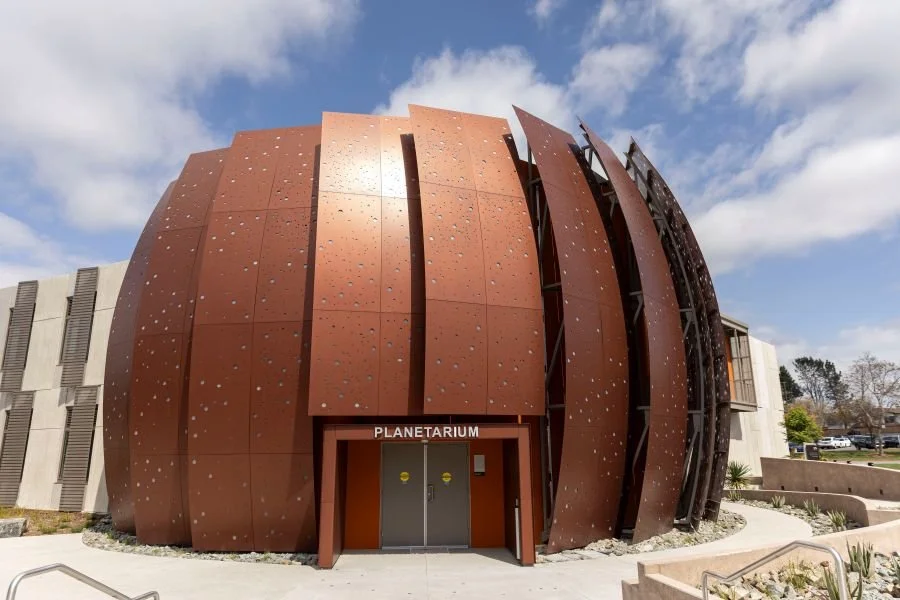
SWC Building 25

Please Note: recommended for guests six (6) years and older due to lighting/effects.
$5.00 Early Bird discount is available until October 30th at midnight. Please contact Programs Director or Communications Director for the discount code.
Witness the power of this fully operational planetarium with subject matter expert Grant J. Miller, Professor of Astronomy.
The Southwestern College (SWC) Planetarium serves as a high-tech gateway to the cosmos, bridging the gap between theoretical classroom learning and the cutting-edge requirements of the modern workforce. By integrating the core principles of the SWC Astronomy program, the planetarium provides students and the community with an immersive environment to explore the physical processes governing the universe—from the origin of galaxies to the behavior of black holes and pulsars.
A new SKYMASTER ZKP 4 LED planetarium projector, manufactured by Carl Zeiss Jena GmbH (Jena, Germany) was installed in the SWC planetarium in July 2026. The ZKP 4 boasts the world-renowned Zeiss sky, unparalled for it precision and beauty. The projector uses Zeiss glass fiber technology for projecting the "fixed stars" and other objects visible to the naked eye. Every star, nebula, star cluster, and galaxy projected by the ZKP 4 is illuminated by a separate fiber. The projector moves in four axes at variable speeds allowing it to demonstrate the effects of Earth's rotation, changing latitude, Earth's precession, and changing heading. Every naked-eye planet, the Sun, and the Moon has its own projector that moves in two axes allowing them to replicate the apparent motions of these objects relative to the background, or "fixed," stars. (The term "fixed stars" is used to differentiate stars from planets--the word planet comes from the ancient Greek term for the "wandering" stars because planets appear to move relative to the background stars.)
Disabled parking is available in Lot C, directly across from Bldg 25.